How to write the first line of a cover letter: 5 openings

By Amil Abbasov
· 5 min read
How do you write the first line of a cover letter? Say which job you want and give one specific fact that fits it, in a single sentence. "I am applying for the Billing Analyst role. For three years I have reconciled about 600 supplier invoices a month" does both. "I am writing to express my interest in the position" does neither, and the reader has seen it hundreds of times.
The first line matters because many readers decide in a few seconds whether to continue. It does not need to be clever. It needs to be specific enough that it could not be pasted into another letter.
All names, companies and numbers below are invented to show the pattern. Replace them with facts from your own work.
What should the first sentence of a cover letter do?
Three things, in this order:
- Name the role. Use the exact title from the advert, so the reader knows which pile your letter belongs in.
- Give one reason you fit. A result, a skill the advert asks for, or a real connection to the employer.
- Make the next line worth reading. The second sentence should be able to start with "For example" or "Here is how".
Put practical details such as where you found the job in the subject line or the email, not in the opening. A subject line like "Application: Billing Analyst (ref. 2291)" saves a sentence.
Which opening types work, with weak and strong examples?
1. The role plus your strongest match
The safest opening and usually the best. It works when your experience clearly matches the advert.
- Weak: "I am writing to apply for the position advertised on your website."
- Stronger: "I am applying for the Billing Analyst role. For three years I have reconciled about 600 supplier invoices a month for a regional distributor."
2. A result you produced
Use it when you have a change you can explain honestly. If you cannot say how you measured it, describe the change in words instead of a number.
- Weak: "I am a results-driven professional with a passion for sales."
- Stronger: "I am applying for the Account Manager role. Last year I moved our slowest-paying clients to 14-day terms, and overdue invoices fell from about one in five to about one in ten."
3. A referral or real connection
Only if it is true and the person agrees to be named. Ask them first.
- Weak: "I know your company is looking for talented people."
- Stronger: "Leyla Hasanova, your head of support, suggested I apply for the Team Lead role after we worked together on the 2024 help-centre rewrite."
4. Something specific about the employer
Use a fact from the company's own site or a public announcement, and link it to what you do. Never flatter in general terms.
- Weak: "I have always admired your company's reputation."
- Stronger: "Your site says you will open a second warehouse next year. I have planned deliveries for a similar move, and I would like to apply for the Operations Coordinator role."
5. A short problem-and-answer opening
This suits creative and marketing jobs. Keep it to two sentences and make sure the second one names the role.
- Weak: "Have you ever wished your newsletter would get more clicks?"
- Stronger: "Your last three newsletters opened with a product list. I would test opening with one customer question. I am applying for the Email Marketer role and have a short example attached."
Which openings should you avoid?
Cut these, even if they are polite:
- "I am writing to apply for..." with nothing after it. It is not wrong, but it uses your best line to say what the subject line already says. Add the reason you fit in the same sentence.
- Adjectives about yourself. "Hard-working", "motivated" and "passionate" are claims. A fact is proof.
- A quotation or a joke that has nothing to do with the job.
- Your life story. Save it for the interview, if they ask.
- Anything you could not back up when the interviewer asks "tell me more about that".
A quick test: swap the company name for another company. If the first line still works, it is too generic. Rewrite it with a detail from the advert or your work.
How long should the first line be?
One or two sentences, roughly 25 to 45 words. Longer than that and the point gets buried. The rest of the paragraph can add one more supporting fact and a link to the employer's need, but the first sentence should be able to stand on its own.
If you are applying with little experience, use a project, a course result or volunteer work as your fact. Our guide on writing a cover letter with no experience shows how.
Does the first line change by country?
The conventions differ. Some employers expect a formal greeting and a longer introduction, others prefer a direct start. Look at the advert, the company's own wording and any instructions on the application form, and follow those. If the advert says "no cover letter", do not send one.
A 5-minute method to write yours
- Copy the job title and the top three requirements from the advert.
- Write down the one thing from your work that matches the first requirement. Include a number only if you can explain it.
- Combine them: "I am applying for [title]. [Your fact]."
- Read it aloud. If it sounds like a form, cut the filler words.
- Run the company-name swap test.
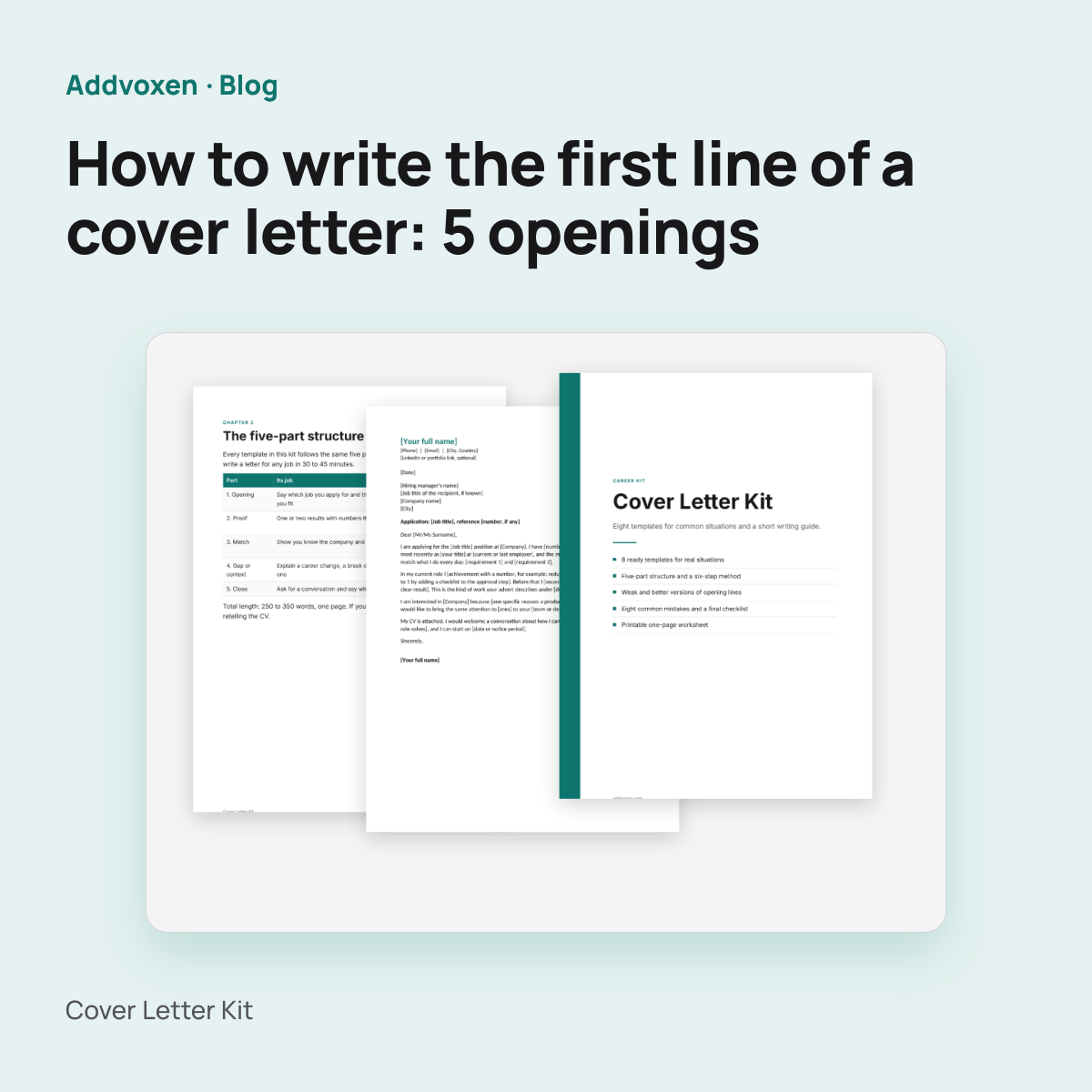
The full structure around the opening, with a worked letter, is in how to write a cover letter: structure and a worked example. If you want editable templates for different situations, such as a career change or a first job, the Cover Letter Kit has eight letters with opening lines you can adapt. Whatever you use, make each line true of your own experience.