How to write a cover letter: structure and a worked example

By Amil Abbasov
· 5 min read
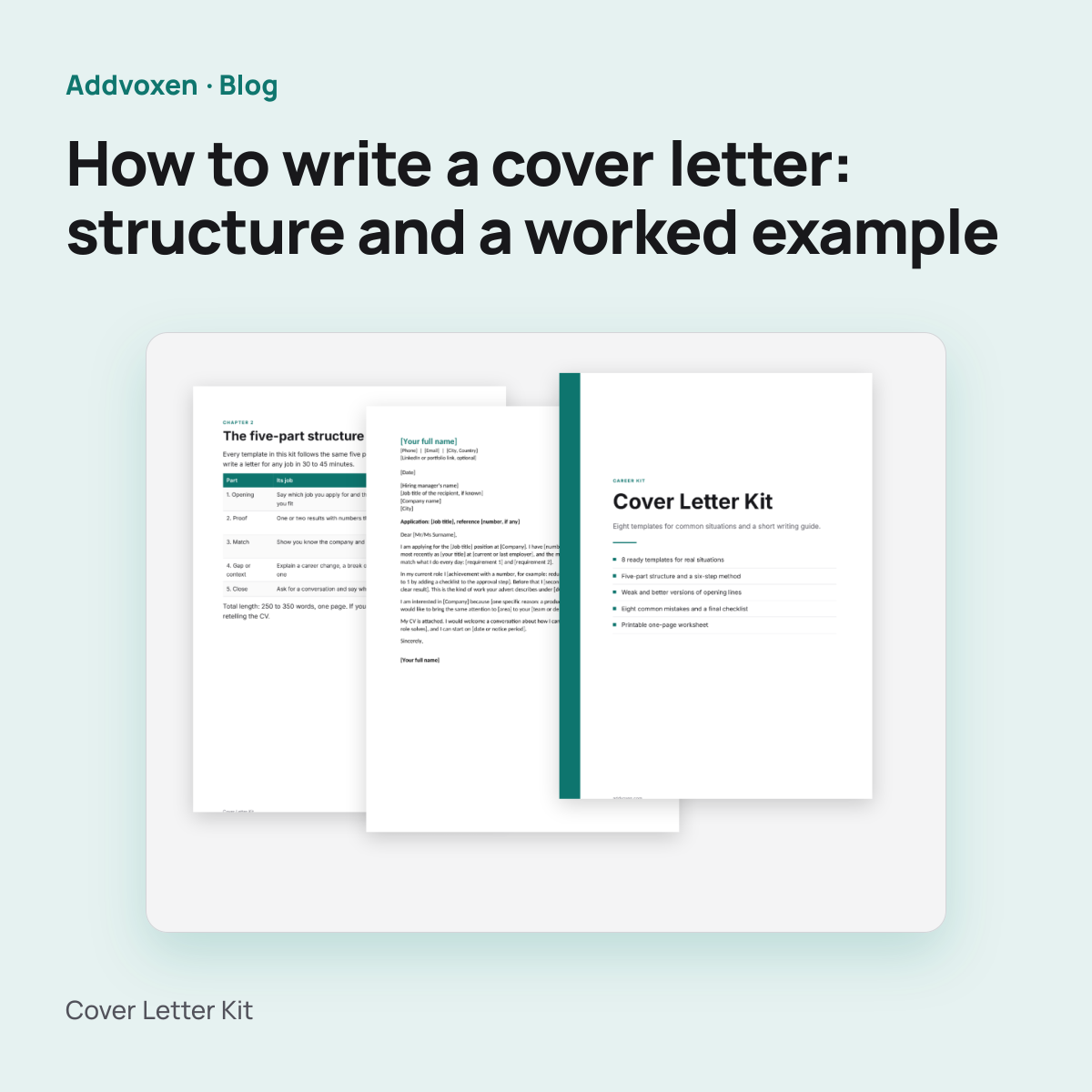
How do you write a cover letter? Keep it to one page and five short parts: a greeting, an opening that names the job and your strongest match, one or two paragraphs of proof, a line about why this employer, and a plain close. Most guides suggest roughly 250 to 400 words. The letter's job is not to repeat your CV. It is to answer one question for the reader: why should I read this person's CV now?
Below is the structure, a worked example with invented names and numbers, and the mistakes that most often make a letter easy to skip.
What should a cover letter include?
Five parts, in this order:
- Header and greeting. Your name and contact details, the date, and "Dear Ms Rahimova" if you can find the hiring manager's name on the advert or the company page. If you cannot, "Dear Hiring Team" is fine.
- Opening (2-3 sentences). Name the exact job you are applying for and give your single strongest match to it, with a fact or a result.
- Proof (one or two short paragraphs). Pick two or three requirements from the advert and show one example for each. Use what you did, what changed and, where you honestly can, a number.
- Why this employer (2-3 sentences). One specific reason you want this company or team, taken from something real: a product, a project, a stated goal.
- Close (1-2 sentences). Say you would like to talk, say you are available, and thank the reader. Sign off with your name.
Leave out your life story, your salary (unless the advert asks), and any claim you cannot back up in an interview.
How do you write the opening paragraph?
The opening decides whether the rest is read, so it should carry information, not politeness. Compare:
- Weak: "I am writing to apply for the position advertised on your website. I believe I am a hard-working and motivated person."
- Better: "I am applying for the Operations Coordinator role. For the past three years I have scheduled deliveries for a regional distributor, and I would like to bring that experience to your logistics team."
The second version names the job, names what you did and links it to the employer's need. Do not open with "Hello, my name is". Your name is already in the header.
What does the body of a cover letter look like?
Take the requirements from the advert and answer the top two or three with evidence. A simple pattern for each paragraph is: the task, what you did, what changed.
Instead of "Responsible for customer emails", write what happened: "I took over the shared support inbox and wrote five reply templates. Most questions were then answered on the same day." If you have numbers from your own work, use them. If you do not, describe the change in words. Never round up or invent a figure to sound stronger, because an interviewer may ask how you measured it.
A worked cover letter example
This example is invented: the company, the names and the numbers are made up to show the structure.
Dear Ms Rahimova,
I am applying for the Operations Coordinator role at Northfield Supplies. For the past three years I have scheduled deliveries for a regional distributor, and I would like to bring that experience to your logistics team.
Your advert asks for someone who can keep schedules reliable. In my current role I plan about 40 deliveries a week across six drivers. When two routes overlapped last spring, I rebuilt the weekly plan in a shared spreadsheet so each driver saw one list. Late deliveries dropped, and the dispatcher stopped taking calls to confirm times.
You also ask for clear communication with suppliers. I write the daily stock update for our warehouse and keep a running log of supplier delays, so the team knows what to expect before they ask.
I am drawn to Northfield because your site says you plan to open a second warehouse next year. I would like to help set up the scheduling for it from the start.
I would be glad to talk about the role. I am available for a call or interview on weekdays. Thank you for your time.
Yours sincerely, Aysel Mammadova
It is about 190 words in the body. Yours will be longer because it will carry your own detail. Notice what is missing: no "passionate", no list of every past job, nothing the CV already says in full.
Which mistakes make a cover letter easy to skip?
- Repeating the CV line by line. Add what the CV cannot show: the reason and the link to this job.
- One letter for every employer. If you could swap the company name and nothing else changes, rewrite the second and third parts.
- Starting with "I". Not forbidden, but if every sentence begins with it, the letter reads as a list about you rather than an answer to their need.
- Going past one page. Cut the weakest paragraph first.
- Typos in the company or person's name. Check both against the advert.
- Different information from your CV. Dates and job titles must match.
Is a cover letter always needed?
Not always. If the advert says "no cover letter" or the form has no place for one, do not send one. If the advert asks for one, write it. If it is optional, a short targeted letter can help when your CV alone does not explain a career change, a gap or a move to a new country. Employers differ, so follow the instructions in the advert.
Checklist before you send
- The job title and company name are spelled as in the advert.
- The first two sentences say what you want and why you fit.
- Each claim has an example behind it.
- Every number is true and you can explain it.
- One page, saved as PDF unless the advert asks for another format.
- The file name includes your name, for example
Aysel-Mammadova-cover-letter.pdf.
If you want a head start, our Cover Letter Kit has eight editable letters for common situations such as a career change or a first job. Whatever you use, edit every line so it describes your real experience. For the CV that goes with the letter, see how to write an ATS-friendly CV.