How to make a monthly budget and pay off debt in order

By Amil Abbasov
· 4 min read
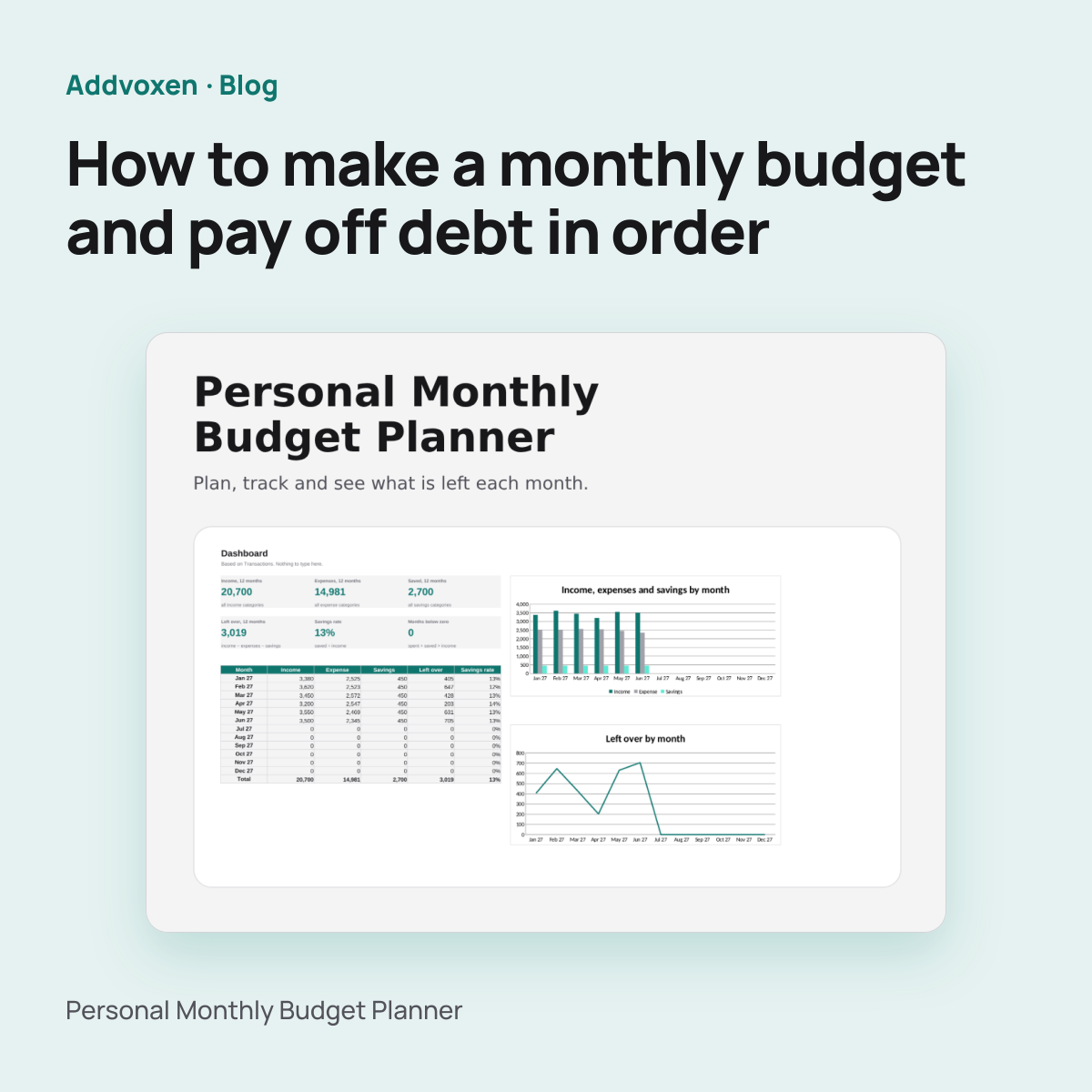
To make a monthly budget and pay off debt, write down your take-home income, subtract fixed costs, minimum debt payments and a small savings amount, and give every remaining unit of money a job. Whatever you can spare goes to one debt at a time, while the others get their minimum. That is the whole method. The rest of this guide shows it in a spreadsheet with invented numbers.
What does a monthly budget need to include?
Five blocks, in this order:
- Take-home income. What reaches your account after deductions, not the gross figure. If your income varies, use the lowest month of the last six.
- Fixed costs. Rent, utilities, phone, transport, insurance.
- Variable costs. Groceries and everything else you spend on. Set a planned amount per category.
- Minimum debt payments. The smallest amount each lender requires.
- Savings. A small fixed amount, even while in debt, so one broken appliance does not go on a card.
The rule that makes it work: income minus all five blocks equals zero. Money left unassigned tends to disappear without being noticed.
How do you set it up in a spreadsheet?
Use three areas.
Settings. One row per category with its type (income, expense, savings) and a planned amount per month.
Transactions. One row per payment: date, description, category and amount. Pick the category from a dropdown (Data validation) so spelling never splits a total.
Monthly summary. For each category, planned and actual:
- Actual:
=SUMIFS(Transactions!D:D, Transactions!C:C, A2, Transactions!A:A, ">="&start, Transactions!A:A, "<"&end) - Difference:
=planned - actual - Status:
=IF(actual>planned,"Over","OK")
Add one cell for what is left: =income - expenses - savings. Review it weekly, not monthly, so an overspent category is caught while there is still time to adjust.
What does a worked budget look like?
All numbers are invented. Monthly take-home income: 2,000.
| Block | Amount |
|---|---|
| Rent | 650 |
| Utilities | 120 |
| Groceries | 350 |
| Transport | 100 |
| Phone | 25 |
| Everything else | 155 |
| Minimum debt payments (30 + 60 + 150) | 240 |
| Savings buffer | 160 |
| Extra payment to debt | 200 |
| Left unassigned | 0 |
The extra 200 is what the budget leaves after everything else. It is the number that decides how fast the debt disappears.
How do you pay off debt in order: snowball or avalanche?
List each debt with its balance, interest rate and minimum payment. Our invented debts:
| Debt | Balance | Yearly rate | Minimum |
|---|---|---|---|
| Store card | 600 | 18% | 30 |
| Credit card | 2,400 | 24% | 60 |
| Personal loan | 5,000 | 8% | 150 |
Both methods pay every minimum. They differ in where the extra 200 goes.
- Snowball: extra goes to the smallest balance first (store card). You close accounts early, which many people find motivating.
- Avalanche: extra goes to the highest interest rate first (credit card). It costs less interest.
When a debt is cleared, its minimum payment moves to the next debt. That roll-over is what makes the payments grow.
We calculated both in a short script, charging interest monthly at one twelfth of the yearly rate:
| Method | First debt cleared | All debts cleared | Total interest |
|---|---|---|---|
| Snowball | month 3 | month 21 | about 841 |
| Avalanche | month 11 | month 21 | about 833 |
| Minimums only, no extra | month 24 | month 81 | about 3,230 |
The snowball and the avalanche finish in the same month here, and the avalanche saves only about 8 in interest. The big difference is between paying extra and not paying extra. Real lenders compound differently and change rates, so use your own statements and treat these figures as an illustration of the method.
If the numbers are close, choose the order you will actually stick to. A plan you abandon in month four costs more than the extra 8.
What should you check every month?
- Did each category stay within plan? If one is over every month, change the plan, not the guilt.
- Is the extra payment actually going to the target debt?
- Did a debt reach zero? Move its minimum to the next one.
- Is the savings buffer intact?
Rules on interest, fees, early repayment and debt collection differ by country and lender. Check your loan contract and your local rules before changing how you repay.
Our Personal Monthly Budget Planner has these sheets ready in Excel and Google Sheets: categories, transactions, a monthly view with Over and OK status, savings goals and a Debt Payoff sheet with a snowball and avalanche ranking. If you also run a business, see how to make a 12-month cash-flow forecast for the same method on business money.