How HR Teams Can Use AI to Write Fair Job Descriptions

By Amil Abbasov
· 4 min read
HR teams can use AI to write fair job descriptions by giving the model the real requirements, asking it to separate must-haves from nice-to-haves, and then asking it to flag exclusionary wording in its own draft. The model drafts. A person decides what the job really needs and signs off. If you skip either step, the AI will write a polished ad that repeats whatever is vague or biased in your input.
This guide gives you a four-step routine, a prompt for each step and a checklist for the final review. It works in ChatGPT, Claude and Gemini.
Why can AI-written job descriptions end up unfair?
A model writes what is typical. Typical job ads are full of "rockstar", "digital native", "strong leader" and a list of ten "requirements" where only three are truly required. If you ask for "a job description for a sales manager", you get that average back.
Wording matters because candidates read it as a signal of who belongs. A well-known study, Gaucher, Friesen and Kay (2011, Journal of Personality and Social Psychology), found that job ads with more masculine-coded words made the job seem less appealing to women. Read the paper itself before you rely on its details, and treat it as a reason to check your wording, not as a rule for every market.
Other common problems are easy to spot once you look:
- Inflated requirements. "10 years of experience" for a role that needs two.
- Age signals. "Digital native", "young and dynamic team".
- Unneeded demands. "Must be able to lift 20 kg" in an office job.
- Vague culture words. "Culture fit" can quietly mean "like us".
What should you prepare before you open the AI?
Write down five facts. The model should not invent them.
- The job title and who it reports to.
- The three to five tasks that fill most of the week.
- The skills needed on day one, and the skills someone can learn in the first six months.
- Pay range and location or remote arrangement, if you can share them.
- How the process works: number of interviews and the decision date.
If you cannot separate day-one skills from learn-on-the-job skills, stop here and ask the hiring manager. This is the single most useful step for fairness, because shorter, honest requirements let more qualified people apply.
How do you draft the job description with AI?
Paste the five facts and use a prompt like this:
Write a job description for a [title] at a [type of company, size]. Use only the facts below. Do not invent benefits, perks or requirements. Structure: one short paragraph about the role, "What you will do" (4-6 bullets), "What you need" (only the day-one skills), "What you can learn here" (the learn-on-the-job skills), "Pay and conditions", "How we hire". Plain language, no jargon, no slogans. If a fact is missing, write [MISSING] instead of guessing.
Facts: [paste them]
The [MISSING] instruction matters. Without it, models tend to add generous-sounding benefits you do not offer, and that is a promise you would have to break later.
How do you ask the AI to check for bias?
Run the draft through a second prompt in a new message:
Review this job description for wording that could discourage qualified applicants. Check for: gender-coded words, age signals, unnecessary physical or cultural requirements, requirements that look inflated for the stated tasks, and jargon. For each issue, quote the phrase, say why it may exclude people and suggest a plain alternative. Do not rewrite the whole text.
Asking for quotes and reasons lets you judge each suggestion. Some will be wrong, and some will be missing. A model can also flag a legitimate requirement as biased, such as a licence the law requires. Keep it when the job truly needs it.
Dedicated tools exist for this check too. Their vendors publish their own accuracy claims, so test any tool on your own old postings before you trust it.
What must a person check before posting?
The AI cannot know your legal context, your pay-transparency obligations or your real team. Go through this list yourself:
- Every requirement is tied to a task listed above. Delete the ones that are not.
- The year-of-experience numbers match what the manager would accept.
- The pay range and benefits are true and approved.
- Nothing describes a person's age, gender, family status, nationality or appearance, unless the job truly requires it.
- The text says how to ask for adjustments in the process, for example for a disability.
- Someone who did not write the ad has read it, ideally a person from outside the hiring team.
- The rules for job ads and pay disclosure in your country or region are confirmed locally. They differ widely and change, so check them with your legal adviser or the labour authority.
What about screening CVs with the same tools?
Writing the ad is the safest use of AI. Ranking or rejecting candidates automatically is much riskier, because the model can pick up patterns that proxy for protected traits. Several regions are now regulating automated hiring decisions, so check what applies to you. A safer pattern: use AI to summarise CVs against your written criteria, and let a person make every decision.
Where do you find ready prompts for the rest of the process?
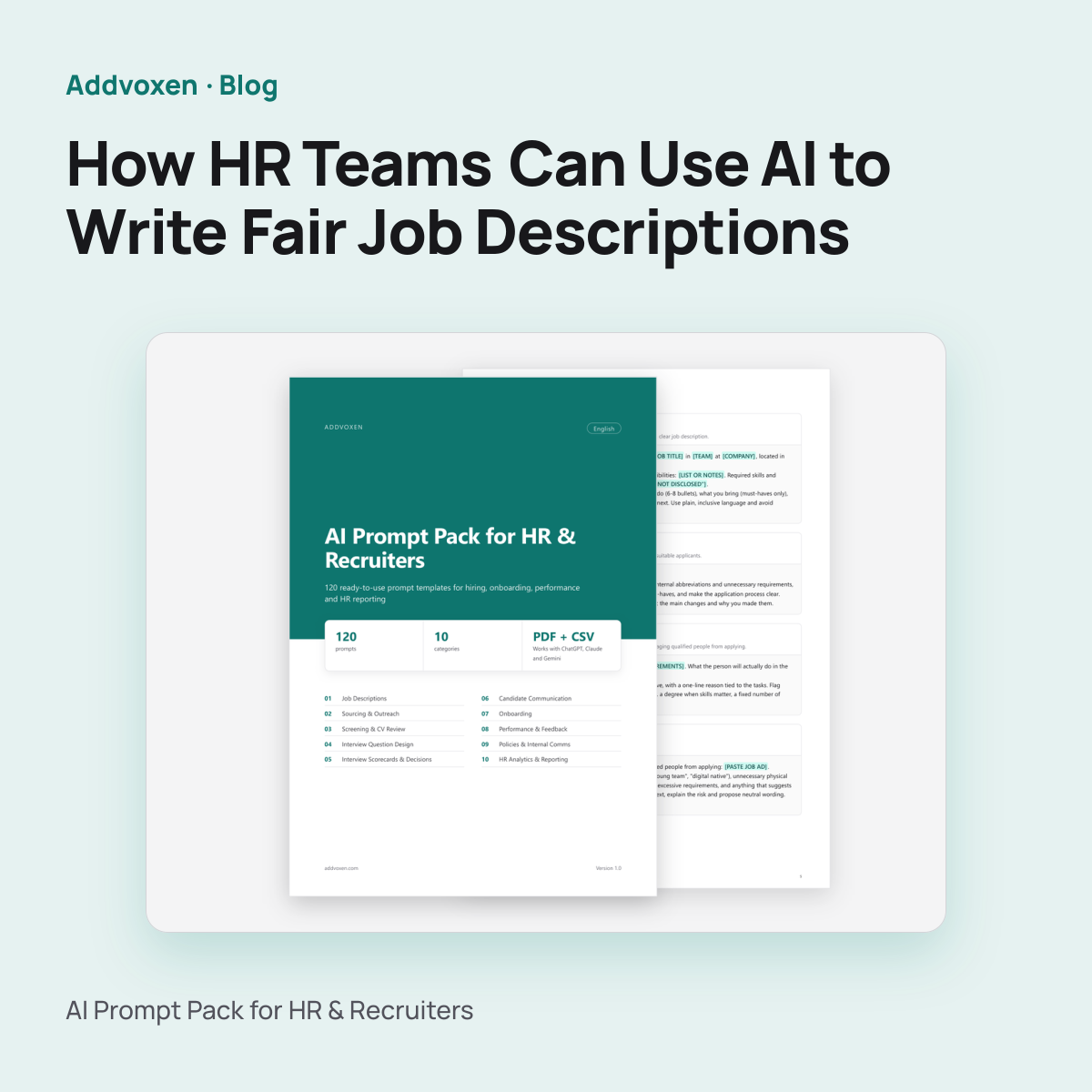
The routine above works for one document. If you also need prompts for outreach messages, interview questions, scorecards and candidate emails, our AI Prompt Pack for HR & Recruiters has 120 of them in 10 categories, written for fair hiring and with a short responsible-use note. For writing prompts in general, see ChatGPT prompts for marketing that give usable copy: the same context-block method applies to HR texts.