CV vs resume: what is the difference and which to send

By Amil Abbasov
· 4 min read
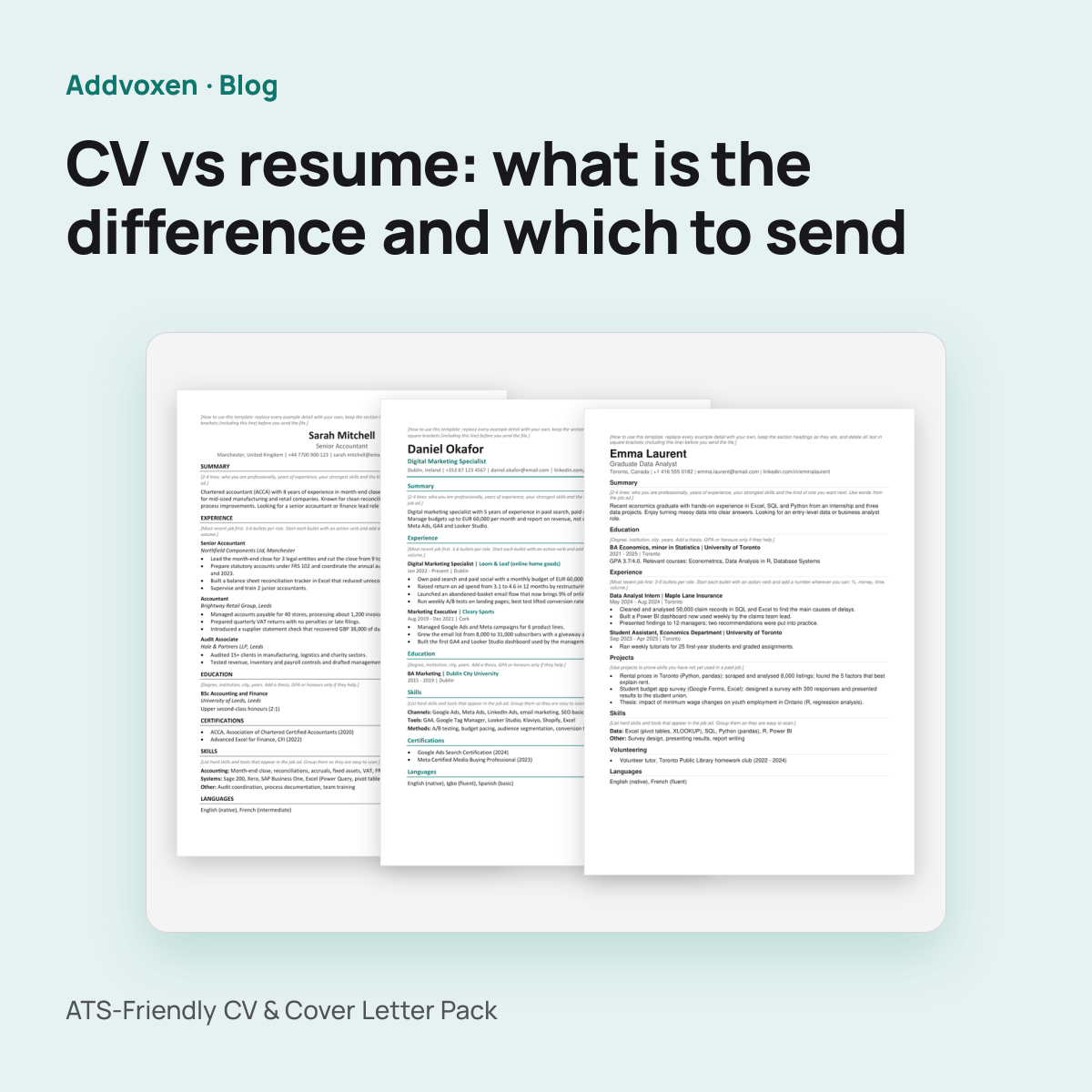
CV vs resume: what is the difference, and which one should you send? In most business jobs, nothing meaningful. Employers in the UK, Europe, the Middle East, Azerbaijan, Turkey and the Russian-speaking countries say "CV" and mean a short, targeted document of one to two pages. In the US and Canada the same document is called a "resume". The one real exception is academic, research and medical work, where a "CV" means a long, complete record.
So the practical rule is simple: send what the job advert asks for, in the length that fits the role. The rest of this guide shows how to tell which case you are in.
What is the difference between a CV and a resume?
The two words describe two documents, but which document depends on where you are.
| Short, targeted document | Long, complete record | |
|---|---|---|
| Typical name | Resume (US, Canada) or CV (most other countries) | CV (academic and research use everywhere) |
| Typical length | 1-2 pages | As long as the career, often 3 pages or more |
| Content | Work history and skills chosen for one job | Everything: publications, grants, teaching, conferences |
| Changes per application | Yes, tailored each time | Updated, but not shortened |
Career sites do not agree on every detail, and some describe the split as global when it is mostly regional. That is why the advert beats any general rule. Treat the table as a guide to the usual meaning, not a law.
Which one do employers expect in your country?
Look at the words in the advert first, then at the market.
- US and Canada: "resume" means the short document. Employers there use "CV" mainly for academic and research roles.
- UK, Ireland, Australia and most of Europe: "CV" means the short document for ordinary jobs. "Resume" is understood and usually accepted as the same thing.
- Azerbaijan, Turkey and the Russian-speaking countries: the local words (CV, özgeçmiş, резюме) usually mean the short document too. Some employers in Turkey and Azerbaijan still expect extra personal fields, so read the advert. Our guide on whether to put a photo on your CV covers that part.
- International employers: follow the employer's country, not yours.
If the advert says "send your CV" or "send your resume", send the short document unless the role is academic. Do not send a four-page record to a company that wanted a page and a half.
When do you need a full academic CV?
Send the long version when the job is in one of these areas:
- University teaching or research positions.
- Research institutes and scientific labs.
- Grant, fellowship and PhD applications.
- Clinical and medical roles, where licences and training must be listed in full.
In these cases, include sections that a normal resume does not need: publications, conference talks, teaching experience, grants, memberships and references. Keep the order clear, put the newest item first in every section and do not trim for length. Reviewers expect the whole record.
If you are not sure, check the employer's careers page or the application form. If it lists fields such as "publications", it wants the long version. If you cannot tell, ask the recruiter in one line.
How do you decide in three questions?
- Is the employer a university, lab or clinic? If yes, send the full CV.
- Does the advert name a document and a length? If yes, do exactly that.
- Neither? Send a short, targeted document of one or two pages, whatever the advert calls it.
Then name the file clearly, for example Firstname-Lastname-CV.pdf, so the employer knows at once what it is.
What does a short CV or resume contain?
The same core, whichever name you use:
- Name, city and country, email, phone and one profile link.
- A two-line summary written for this job.
- Work history, newest first, with results and numbers you can verify.
- Skills that appear in the advert, only the ones you really have.
- Education and, if relevant, certificates.
If your CV goes through screening software, keep it single-column and plain. Our guide to an ATS-friendly CV explains what the software reads and what breaks it.
Can you keep one master document?
Yes, and it is the easiest way to avoid the whole question. Keep one long master file with every job, project and achievement. For each application, copy it and cut it down to the one or two pages that fit the advert. For an academic application, send the master almost as it is. You write the long record once and edit it many times.
Quick checklist before you send
- I checked the advert for the words "CV" or "resume" and for a length.
- The employer is not an academic or research body, or I am sending the full version.
- The document is tailored to this role.
- The file name has my name and the word CV or resume.
- I saved a master version with everything in it.
If you want clean layouts that already follow these rules, the ATS-Friendly CV & Cover Letter Pack includes five editable Word CV templates, two cover letter templates and a writing guide, in English, Azerbaijani, Turkish and Russian.