How to Answer "What Is Your Greatest Weakness?" With Examples

By Amil Abbasov
· 5 min read
The best answer to "What is your greatest weakness?" names one real weakness that the job does not depend on, shows how it affected your work, and then describes what you are doing about it, with one sign of progress. Keep it to about 45 seconds. The weakness is not the point. The proof that you notice problems and fix them is.
Career sites that cover this question, such as MockQuestions, Randstad and Science of People, give the same core advice: be honest, be specific and finish with action. This guide turns that into a structure you can fill in tonight.
What is the interviewer really checking?
Three things. First, self-awareness: can you describe your own limits without defensiveness? Second, honesty: does the answer sound real or rehearsed? Third, whether you improve when you find a gap. Nobody expects a candidate with no weaknesses. A person who says "none" or hides behind a disguised strength looks either unaware or evasive.
What is a four-step structure for the answer?
- Name it plainly (one sentence). "I find it hard to delegate." Use ordinary words, not a slogan.
- Give a short real example (one or two sentences). When did it cost you something? Time, quality or a colleague's growth.
- Say what you changed (one or two sentences). A specific habit, tool or routine, not "I am working on it".
- Show the result so far (one sentence). A small, true outcome. It does not have to be perfect.
Total: five or six sentences. If you go over a minute, cut the example, not the fix.
What makes a weakness safe to choose?
Pick a weakness that passes two tests.
- It is not a core skill for this job. A bookkeeper should not say "I struggle with numbers". A sales rep should not say "I dislike talking to people".
- You can show real progress on it. If you have done nothing about it, choose another one.
Good sources for honest candidates: a skill you learned late (public speaking, a spreadsheet function, writing short emails), a habit from a previous role (delegating, saying no, asking for help early), or a tool you have not used yet but could learn.
What are five worked example answers?
These examples are invented. Replace the details with your own facts.
1. Delegating (team lead). "I used to keep the complex tasks for myself. As a new team lead I worked late while my team was not growing. Now I plan the week with them, give each person one stretch task and review instead of redoing. It is not perfect, but last quarter two colleagues ran client projects on their own for the first time."
2. Public speaking (analyst). "Presenting to large groups does not come naturally. In my first year I read from slides and lost people. I started rehearsing out loud with a timer and asked to open our monthly team call. I am calmer now, and my manager asked me to present the quarterly numbers to the department."
3. Saying no (freelancer or assistant). "I tended to accept every request, and deadlines slipped. Now I check my task list before I agree and reply with a date instead of a yes. Late deliveries dropped from several a month to one in the last quarter."
4. A skill you are still learning (marketer). "I have limited experience with paid ad dashboards, because my last role focused on email and content. I took a free course through the platform's own training site, ran a small test budget for a side project and can now read a basic campaign report. I would be glad to go deeper in this job."
5. Asking for help late (junior developer). "I used to struggle alone for too long before asking questions. Now I set a 30-minute limit: if I am stuck after that, I write down what I tried and ask. My tasks are finishing earlier and my reviewers say my questions are easy to answer."
Which answers should you avoid?
- The disguised strength. "I am a perfectionist" and "I work too hard" sound like an answer you found online. Interviewers have heard them many times.
- A deal-breaker. Naming the main skill the job requires, with no plan to fix it.
- "I don't have any." It signals low self-awareness.
- A confession with no fix. "I am always late" ends the conversation unless it is followed by a change you can describe.
- Blaming others or the past employer. Keep the answer about your own habits.
- Something personal or sensitive. Health, family or politics do not belong in this answer. You are never required to share them in a job interview.
What template can you fill in?
One area I am improving is [weakness in plain words]. For example, [short true situation and its cost]. To fix it, I [specific habit, tool or routine]. So far, [small real result]. I expect to keep getting better at it, and it does not affect the core of this role, which is [main task of the job].
Read it aloud twice and cut any phrase you would not say to a colleague.
How do you adjust the answer for the role?
Read the job advert and list its three main skills. Rule those out as your weakness. Then check the company culture: a team that works in pairs values someone who asks for help early; a client-facing role values someone who admits they are learning to say no. The same honest weakness can be framed differently, but only if the facts stay true.
How should you practise it?
Write your answer in full, then reduce it to five key words (weakness, example, fix, result, link to the role). Practise out loud with a phone timer until it takes 45 seconds. Record it once and listen for hedging words like "kind of" or "maybe". Then ask a friend to follow up with "How do you know it is improving?", because that is the question a good interviewer asks next. Keep one real figure or date ready for that follow-up.
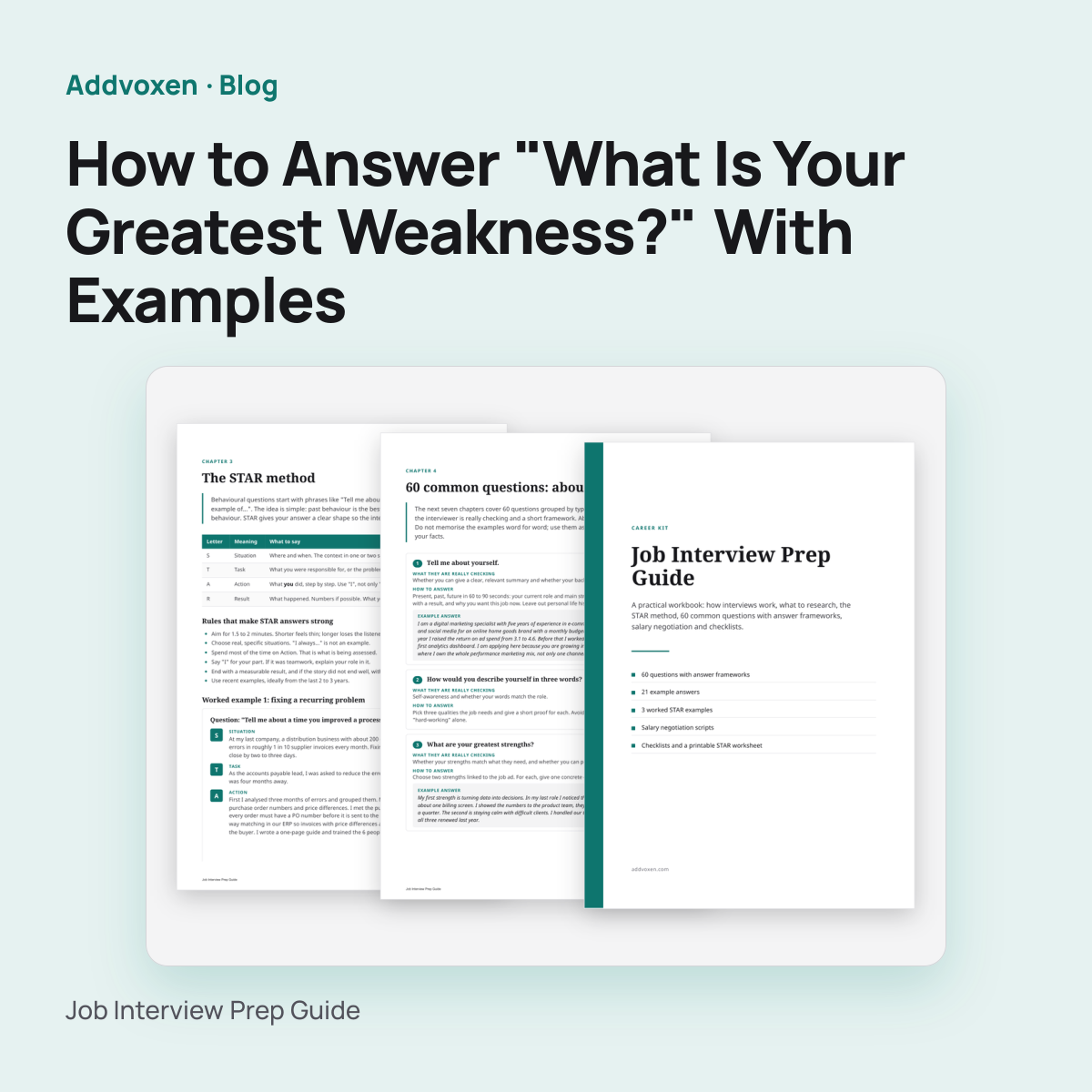
The Job Interview Prep Guide includes this question with an example answer among its 60 common questions, a note on what the interviewer is checking, and a printable story bank where you can store your own examples. It is one of 7 question groups, so you can prepare the neighbouring questions in the same sitting. Our tell me about yourself answer uses the same fill-in approach for the opening question, and the guide's product page lists the full contents.