Tell Me About Yourself": A 60-Second Answer Structure

By Amil Abbasov
· 4 min read
The best way to answer "tell me about yourself" is a 60-second summary in three parts: where you are now (present), how you got here (past) and why this job is the next step (future). Keep only the facts that matter for the role you are applying for. End with a sentence that connects you to this job.
Almost every interview starts with this question. It is not a request for your life story. The interviewer wants to hear whether you can summarise your career clearly and whether it fits the job. Your answer sets the topic for the next questions, so it is worth preparing in writing.
How long should the answer be?
Aim for 60 seconds, which is about 130 to 160 spoken words at a calm pace. Career-coaching pages often suggest anything from 30 seconds to two minutes, so there is no official rule. One minute is long enough to be specific and short enough that the interviewer can steer the conversation. Time yourself once with a phone. If you pass 90 seconds, cut the past section.
What is the present, past, future structure?
This is the structure most career guides recommend, and it works because it follows the order in which people think about a candidate.
- Present (15-20 seconds). Your current role, what you are responsible for and one recent result. If you are a student or between jobs, say what you have just finished or are doing now.
- Past (20-25 seconds). Two or three earlier steps that explain why you are good at the present work. Choose only what is relevant to the target job. Leave out the rest.
- Future (15-20 seconds). Why this role, at this company, is the logical next step. Use words from the job advert, not general goals like "I want to grow".
What template can you fill in?
Copy this and replace the brackets with your own facts:
I am a [job title] at [company], where I [main responsibility]. Recently I [one specific result, with a number if you have one]. Before that, I [earlier step] and [second earlier step], which is where I learned [skill the new job needs]. I am now looking for a role where I can [what the job advert asks for], and that is why this position interests me.
Write it out, then cut every word that does not help the interviewer decide whether you fit.
What does a good answer look like?
The examples below are invented to show the structure. Use your own facts.
Example 1: an experienced candidate. Applying for a marketing manager role.
I am a marketing specialist at a small online shop, where I run the newsletter and paid social campaigns. Last quarter I rewrote the welcome email series, and the open rate went from 31 to 44 percent. Before that I worked for an agency, handling content for six clients, which taught me to plan a calendar and keep to a budget. I am looking for a role with more ownership of the whole channel mix, and your advert describes exactly that.
Example 2: a graduate with little experience. Applying for a junior HR assistant role.
I have just finished a degree in business administration, and my last semester was a project on employee onboarding at a local company. I interviewed eight staff members and wrote a two-page improvement plan, which the company's manager used for the next hire. Alongside my studies I worked part time in a customer service role, so I am used to talking with people under time pressure. I want to start my career in HR, and a role that includes recruitment coordination is the best place to learn.
Both answers name one concrete thing the person did. That detail gives the interviewer something to ask about.
What mistakes should you avoid?
- Reciting your CV. The interviewer has it in front of them. Choose three highlights, not twelve jobs.
- Starting in childhood. Begin with your current work or studies.
- Personal details that do not help. Family and hobbies are fine only if they connect to the job, and you do not have to share them.
- A generic future. "I want to grow in a dynamic company" fits every employer. Mention something specific from the advert.
- Memorising word for word. Learn the three parts and one number per part. A script sounds like a script.
- Running over two minutes. If you do, the interviewer cannot ask what they came to ask.
How do you adapt the answer to a different job?
Keep a master version of your three parts, then change the order of details for each application. Read the advert and underline the three things it stresses most. Make sure your present and past parts mention at least two of them, with proof. A project manager's answer for a construction firm and for a software company can share the same career facts and still emphasise different ones.
How do you practise?
Write the answer, read it aloud twice, then say it once without the page. Record it on your phone and listen for filler phrases and long pauses. Ask a friend one question only: "What would you ask me next?" If their question matches what you want to discuss, your answer is working.
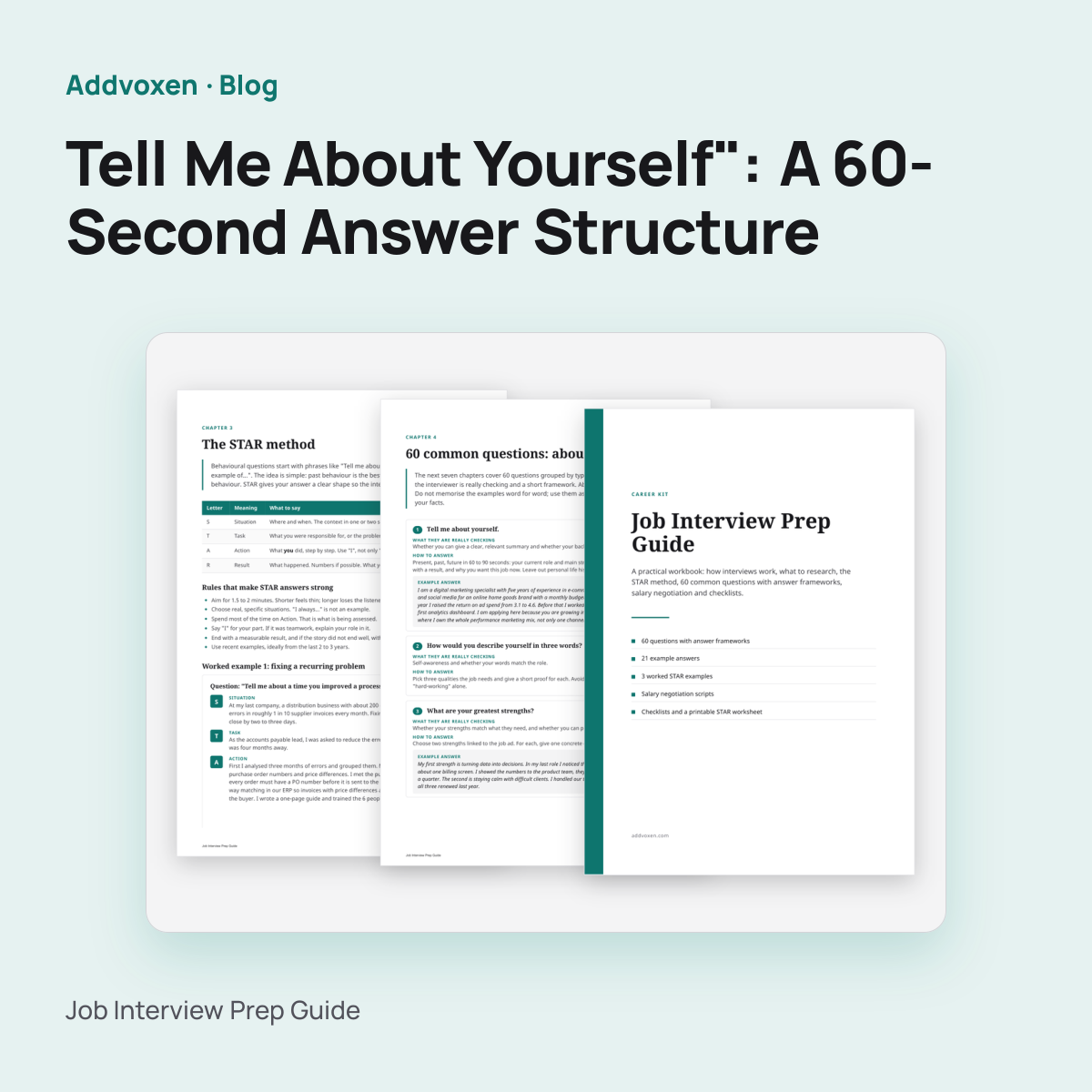
If you want a ready structure for this and 59 other common questions, our Job Interview Prep Guide shows what the interviewer is really checking behind each one and gives an answer framework you can fill in, plus a printable story bank for the examples you will use.
One last check: after you have said your answer, the interviewer should know your current job, your strongest relevant experience and why you applied. If any of the three is missing, add it before the next interview.