How to Answer "What Are Your Salary Expectations?

By Amil Abbasov
· 5 min read
The safest way to answer "what are your salary expectations?" is to give a range that starts at a number you would happily accept, after you have researched the role and learned a little about the job. If you are asked too early, say you would like to understand the role first and ask what range the company has budgeted. Never name a figure you have not worked out beforehand.
Employers ask this question to check that you fit their budget and to see whether you know your market value. Whatever you say becomes the anchor for the rest of the talks. Once you have named a number, it is hard to negotiate above it. Preparing the answer in advance is therefore worth an evening.
What three numbers do you need before the interview?
Write these down before any call:
- Your floor. The lowest monthly pay at which the job still makes sense after your rent, transport and other fixed costs. Below this you say no.
- Your target. The pay you would be glad to accept for the role, based on market research.
- Your stretch. The figure you would ask for if the company clearly wants you and the role has more scope than the advert says.
Example (invented figures): floor 2,400, target 3,000, stretch 3,600 per month. Only your target and stretch are ever spoken aloud. The floor is private: it tells you when to walk away.
How do you research what the job pays?
Use three kinds of source and compare them:
- Salary ranges in the advert. Some adverts include them, and in some places employers must publish them. Rules differ by country, so check your local rules.
- Salary surveys and job boards. Look at at least three adverts for the same title, city and seniority. Official statistics offices and professional associations publish pay data for some professions.
- People in the field. Ask two or three peers what a role like this pays at companies of that size.
Write down the source next to each number. A claim such as "similar roles pay 2,900 to 3,400 in this city, according to three adverts I found" is far stronger than "I feel I am worth about this much".
How do you turn your target into a range?
Start the range at your target and end it a little above, not at your stretch. A range of 3,000 to 3,500 works for the example above. Employers often hear the bottom of a range as your real number, so the bottom must be one you are happy with. Keep the range narrow: a gap like the one in our example (about 15 percent) reads as a researched figure, while 2,500 to 5,000 reads as a guess.
Check whether the figure is monthly or annual, gross or net, and say which. Confusing the two is a common reason for a mismatch at the offer stage.
What can you say in each situation?
The application form asks for a number. If the field is optional, leave it empty. If it is required, enter the middle of your range, or type a short phrase such as "negotiable" only if the form accepts text. Do not enter 0.
A recruiter asks on the first call. Try:
I would like to understand the role and the responsibilities better first. Could you share the range you have budgeted for this position?
If they insist on a number first, give the range:
Based on what I have seen for similar roles in this city, I am looking at 3,000 to 3,500 a month, depending on the full package and the scope of the job.
The interviewer asks late in the process. Link your range to your value:
For a role with this scope, I am looking at 3,000 to 3,500. In my last job I took over the monthly reporting and cut the time it took from three days to one, and I would bring the same approach here.
(That is an example sentence; use your own real result.)
They ask what you earn now. You may answer, redirect or decline politely. Some places restrict this question, so check your local rules. A neutral reply is: "I would rather focus on what this role is worth and what I would bring to it."
What mistakes should you avoid?
- "Whatever you think is fair." It hands all the control to the employer.
- Naming your stretch first. It can end the process before it begins.
- A single number with no research behind it. You cannot defend it if challenged.
- Ignoring the rest of the package. Holiday, remote days, bonus, training and equipment all have value. Ask about them after the base pay is clear.
- Giving a number before you know the role. The same title can mean very different work.
What if the offer comes in below your range?
Thank them, ask for a day, and compare the offer with your floor. If it is above your floor but below your target, ask for either a higher base or a review after three or six months with written goals. If it is below your floor, say politely that you cannot accept it at that level and ask whether there is flexibility.
How can you practise?
Say the range aloud five times. The first sentence of your answer should come out without a pause. Then ask a friend to play the recruiter and interrupt with "can you give me an exact number?" so you practise holding your range.
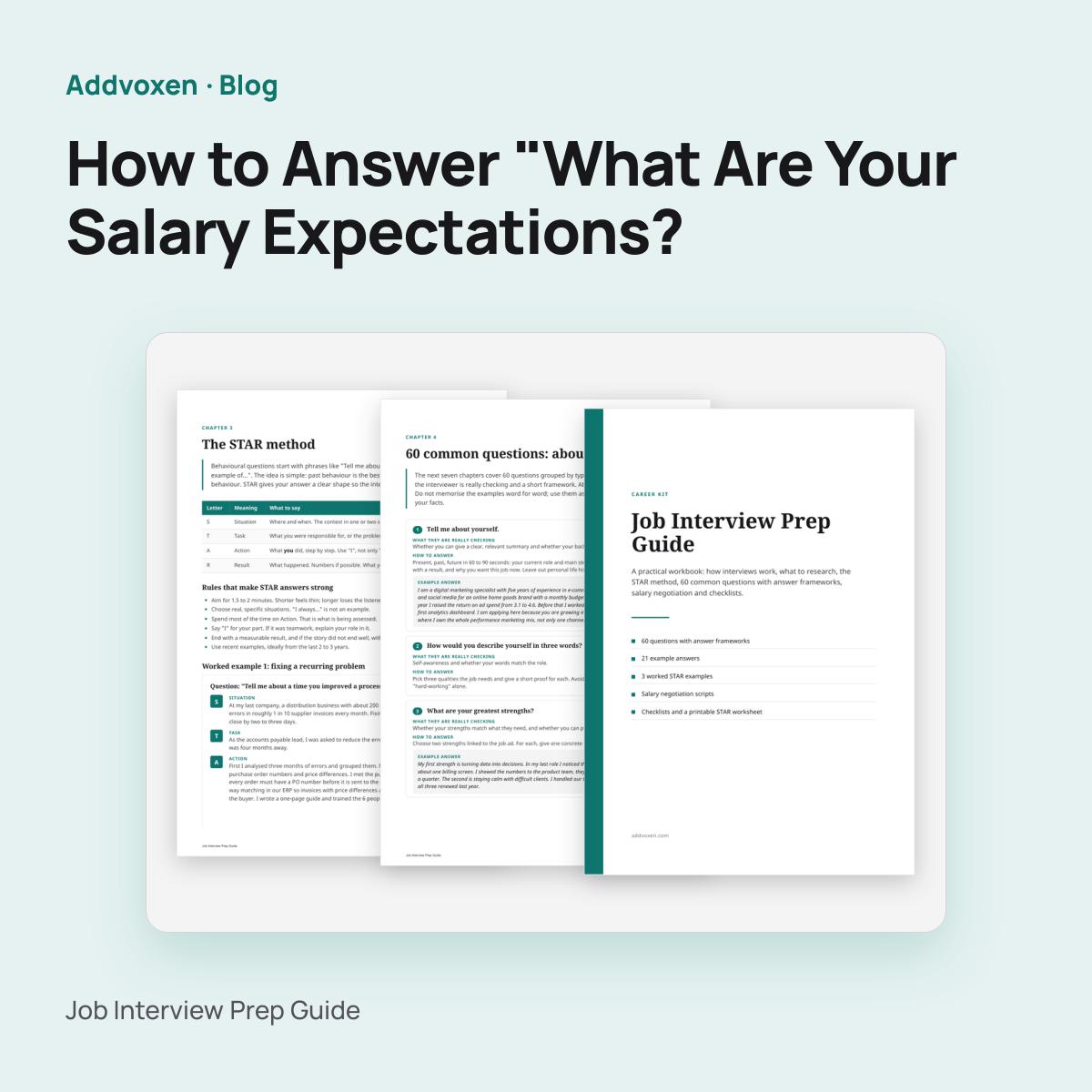
If you want ready wording for more situations, our Job Interview Prep Guide has a salary negotiation section covering market research, your three numbers, timing, the whole package and scripts you can adapt. Pair it with the answer structure in Tell me about yourself so the first and the hardest questions are both prepared.