The STAR Method: How to Answer Behavioural Interview Questions

By Amil Abbasov
· 4 min read
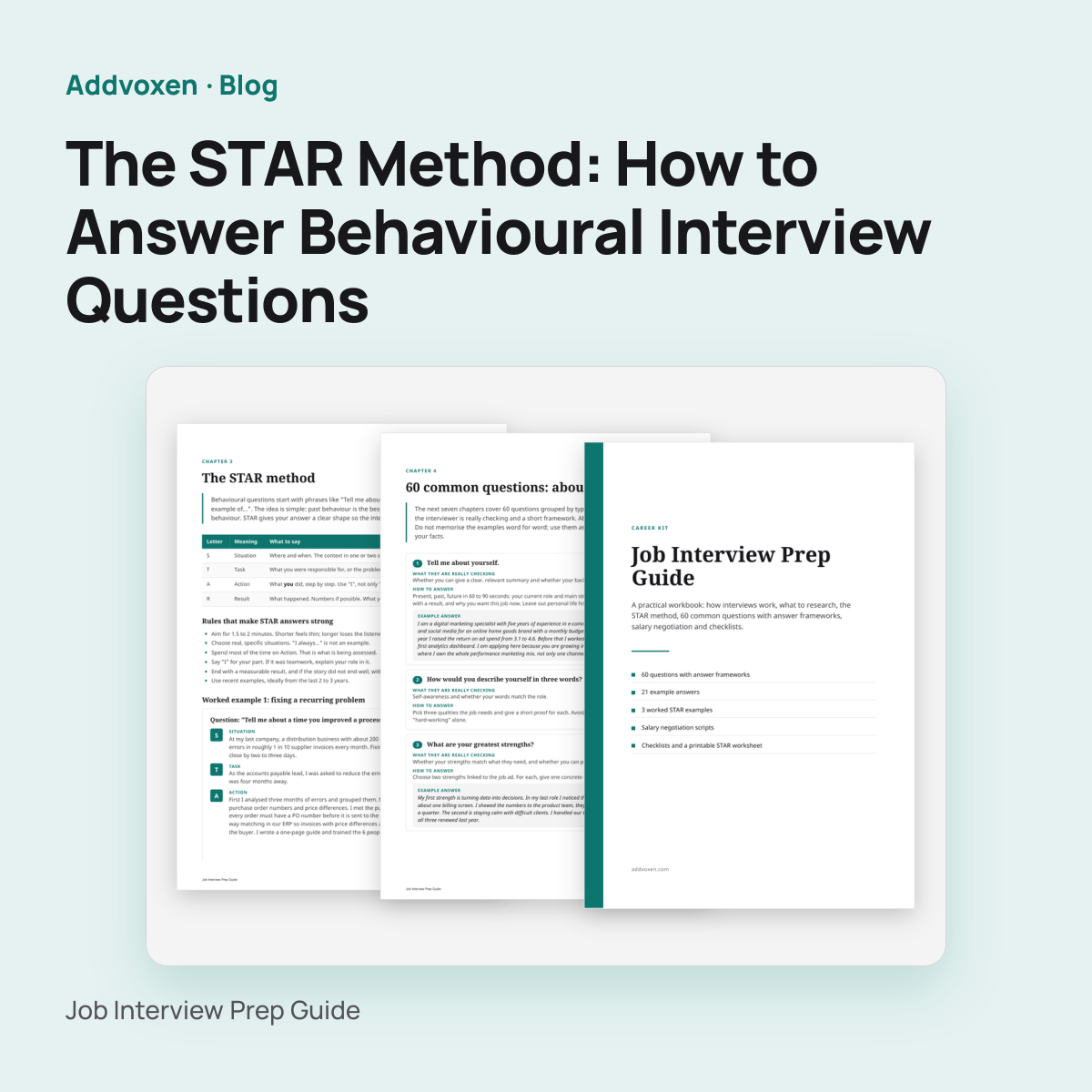
The STAR method is a four-part structure for answering behavioural interview questions: Situation, Task, Action, Result. You describe one real example from your past work in that order, spend most of your time on what you did, and end with the outcome. A good answer takes about two minutes.
Behavioural questions usually start with "Tell me about a time when..." or "How have you handled...". The interviewer is not looking for a theory. They want evidence of how you acted in a real situation, because past behaviour is the best clue to future behaviour. This post shows how to build your answers before the interview, not during it.
What does STAR stand for?
- Situation: the context. Where, when and what was going on. One or two sentences.
- Task: your specific responsibility or goal in that situation. One sentence.
- Action: the steps you personally took. This is the longest part.
- Result: what happened, ideally with a number, and what you learned.
A simple time split: Situation and Task together take about 20 percent of the answer, Action about 50 percent, Result about 30 percent. This is a rough rule of thumb, not an official standard.
What does a weak answer look like compared with a strong one?
Take the question: "Tell me about a time you handled a difficult client."
Weak answer:
We had a client who kept changing the brief. It was stressful, but we worked together and in the end the client was happy.
Nothing here can be checked. "We" hides your part, and "the client was happy" is not a result.
Strong answer:
Situation: I was designing a website for a small clothing shop. In week three the owner asked for a new layout for the third time. Task: I had to finish on the agreed date without working for free on endless changes. Action: I wrote down all three requests, showed the owner how each one moved the deadline, and offered a deal: two more revision rounds inside the price, and a quote for anything beyond that. I also sent a short summary email after every call. Result: The owner approved the layout after the next round, we launched four days later than planned, and the owner hired me for the product photos. I now put a revision limit in every contract.
The example data is invented to show the structure. Use your own real story. The strong version uses "I", names concrete steps and ends with an outcome and a lesson.
How do you build a STAR story step by step?
- Pick the event. Choose something from the last two to three years, if possible. A project, a conflict, a deadline, a mistake, a task you took over.
- Write the Result first. If you cannot state an outcome, pick another story. Count something: hours saved, errors removed, money recovered, people helped. If you have no number, describe a clear before and after.
- Write the Situation and Task in three sentences at most. Cut names, dates and background the interviewer does not need.
- List your actions as verbs. Analysed, proposed, rewrote, called, negotiated, tested. Each action is something you did, not the team.
- Add one sentence of learning. What would you do the same, and what differently? This matters most for questions about failure.
- Say it aloud and time it. Over three minutes means you are telling the background, not the answer.
Which questions should you prepare stories for?
You do not need a new story for every question. Prepare five to six strong stories and match them. Five themes cover most behavioural questions:
| Theme | Typical question |
|---|---|
| Conflict | Tell me about a disagreement with a colleague or client. |
| Pressure | Describe a time you had a tight deadline. |
| Mistake | Tell me about a time you failed. |
| Initiative | When did you improve something without being asked? |
| Leadership or teamwork | Describe a time you helped a team reach a goal. |
One story can often answer two questions. A deadline story, for example, can also be a story about initiative if you proposed the solution.
What mistakes should you avoid when using STAR?
- Saying "we" all the time. The interviewer is hiring you, so make your own part clear.
- Spending half the answer on the situation. Get to the action within 30 seconds.
- Inventing or inflating results. Interviewers often ask follow-up questions such as "How did you measure that?" Only use numbers you can explain.
- Blaming others. In a conflict story, describe the other person's position fairly.
- Memorising word for word. Learn the bullet points of the story, not a script, so you sound natural.
- Ending without a result. If the outcome was mixed, say so and add what you learned.
How can you practise before the interview?
Write your six stories on one page, one line per letter: S, T, A, R. Then read the job advert and mark the three skills it stresses most. Match a story to each. Practise out loud with a friend or a recording, and ask whether the Action part was clear and whether the result was believable.
If you want ready-made structures, our Job Interview Prep Guide includes the STAR method with three fully worked examples and a printable story bank and STAR worksheet, so you can fill in your own stories in one sitting. You can also read how to answer "What are your salary expectations?" in the guide's negotiation chapter.
Whatever you use, the goal is the same: one true story, told in order, with you at the centre and a result at the end.