How to price your freelance work: hourly vs project rates

By Amil Abbasov
· 4 min read
Start with a minimum hourly rate that covers your costs, taxes and unpaid time. Charge by the hour when the scope is unclear. Quote a fixed project price when you can estimate the hours. Both methods use the same number underneath, so work that number out first.
How do I calculate a minimum hourly rate?
Use this formula:
(Income you want to take home + business costs + tax set-aside) ÷ billable hours per year
The input people get wrong is billable hours. You do not bill 40 hours a week. Sales, emails, admin, bookkeeping and gaps between projects are unpaid. Far fewer than 40 hours a week are billable, so measure your own: track one month and count the hours you actually invoiced.
A worked example with invented numbers:
| Item | Per year |
|---|---|
| Income you want to take home | 24,000 |
| Business costs (software, equipment, internet) | 3,000 |
| Tax set-aside (illustrative: 20% of the total below) | 6,750 |
| Total you must earn | 33,750 |
Say you can bill 20 hours a week for 44 weeks, after holidays and sick days: 20 × 44 = 880 hours. Then 33,750 ÷ 880 = 38.35 per hour. Round up to 40.
The tax line is circular, because tax is a share of what you earn: 27,000 ÷ (1 − 0.20) = 33,750, and 20% of that is 6,750. The 20% is only an example. If you are unsure about your rate, read how much to set aside for taxes and confirm the rule locally.
When should I charge hourly?
Hourly pricing fits when:
- the scope is unclear or likely to change;
- the work is ongoing, such as support or maintenance;
- the client wants to be involved and give feedback often.
The downside: the client sees every hour, and faster work earns you less. Send a short time log with each invoice so the number is easy to trust.
When should I charge a fixed project price?
Fixed prices fit when the result is clear: a logo, a 1,500-word article, a website with five pages. The client knows the cost in advance, and you keep the gain when you work efficiently.
How to build the quote:
- List every task and estimate the hours for each.
- Add them up. Say the total is 25 hours.
- Add a buffer for revisions and surprises. A common habit is 15 to 30 percent; pick a number based on how well you know the client. Take 20%: 25 × 1.2 = 30 hours.
- Multiply by your hourly rate: 30 × 40 = 1,200.
- Write down what is included, how many revision rounds you offer and what costs extra.
The last step matters most. A fixed price without a written scope turns into unpaid work.
What about a mix of both?
Many freelancers combine the two:
- Paid discovery, then a fixed price. Charge hourly for the first call or audit, then quote the project once you understand it.
- Fixed price with an hourly rate for extras. "The project is 1,200. Extra changes beyond two revision rounds are 40 per hour."
- Monthly retainer. A set number of hours per month for a set fee, useful for steady clients.
How do I check that my price works?
After each project, compare what you planned with what happened:
- Hours you estimated vs hours you spent.
- What you earned divided by the hours spent: your real hourly rate.
- If the real rate is below your minimum three times in a row, your estimates are too low or your scope is too loose.
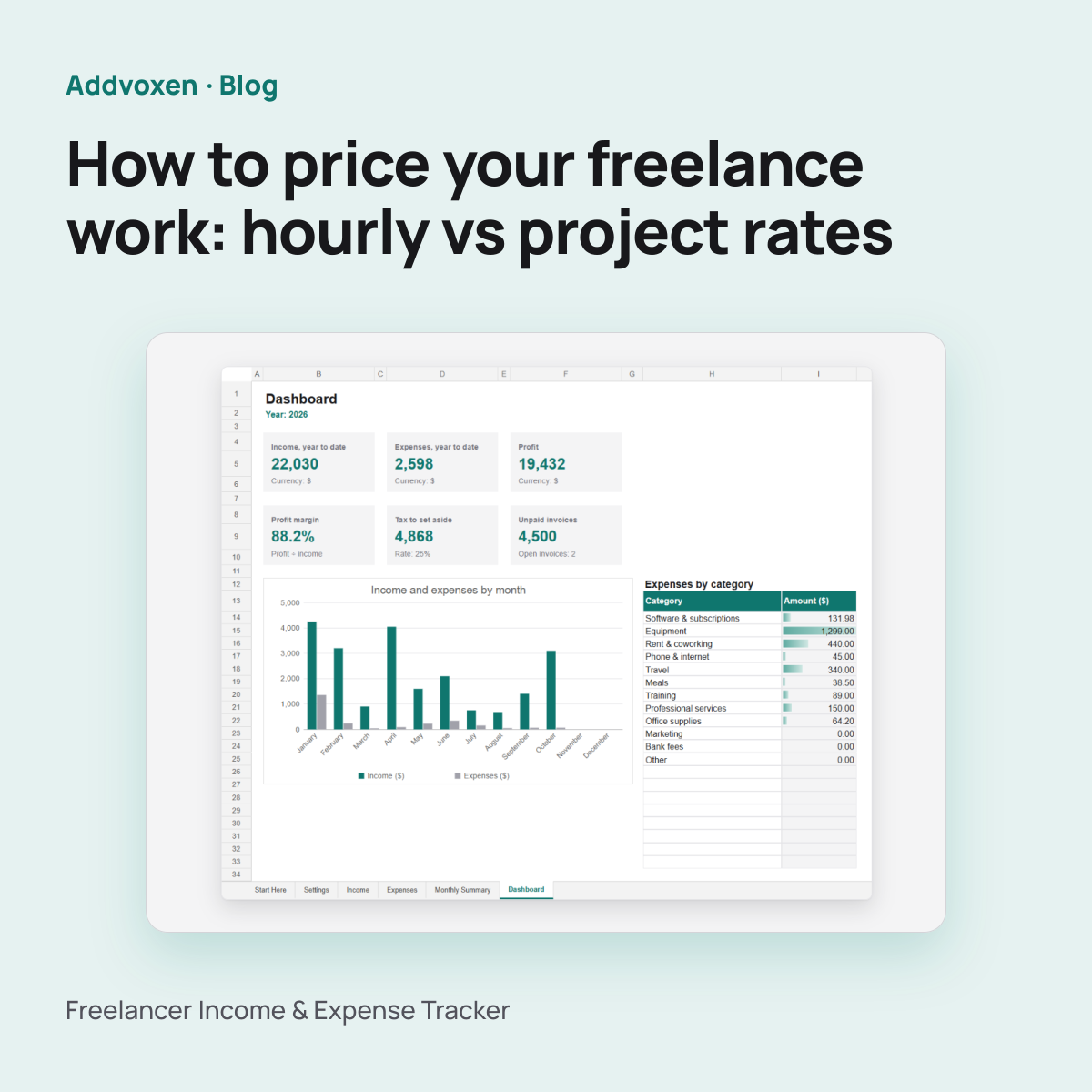
This is where a record helps. If you log the client, project, hours and amount for every job, you can see which kinds of work pay well and which only look busy. A simple sheet is enough; the Freelancer Income & Expense Tracker keeps income, expenses and the tax set-aside in one place, so your real earnings per project are easy to compare with your target.
Common pricing mistakes
- Pricing on 40 billable hours a week. This makes the rate too low from the start.
- Forgetting the tax and cost lines. Your take-home is smaller than your invoice total.
- Quoting without a written scope. Revisions and extras are not free unless you say so.
- Never raising the price. Review your rate once or twice a year, and raise it for new clients first.
- Copying someone else's rate. Another person's costs, market and skills are not yours. Use market rates only as a sanity check.
A short checklist before you send a quote
- Is my minimum rate calculated from real billable hours?
- Did I estimate each task separately and add a buffer?
- Does the quote state what is included and what costs extra?
- Do I know my tax set-aside for this income?
- Would I still accept this job if it takes 30% longer?
If the answer to the last question is no, raise the price or reduce the scope.