How to Prepare for an Annual Performance Review

By Amil Abbasov
· 5 min read
To prepare for an annual performance review, keep a one-page evidence log through the year, not a memory dump the night before. Add one line a month: what you did, what changed, and where the proof is. Two weeks before the review, pick your best five lines, write a short self-assessment and send it to your manager. Then decide what you want from the next year: goals, training, a change of scope or a pay conversation.
This guide covers the full year. If you are only a few months into a job, see how to ask for a pay review after probation.
What is an evidence log and why keep one?
An evidence log is a single table where you record results as they happen. Most people sit down before a review and remember only the last six weeks. A log fixes that. It also protects you from vague wording: if a line has no number, date or document, it is not evidence yet.
HR guides from universities and recruitment firms say much the same thing: keep a running file of accomplishments, save thank-you messages from colleagues, be specific about results, and do not inflate your self-assessment. Your own employer may have its own form and deadlines, so check those first.
What should the log contain?
Five columns are enough. The examples below are invented.
| Month | What I did | What changed | Proof | Goal it links to |
|---|---|---|---|---|
| Feb | Rebuilt the weekly sales report | Takes 20 minutes instead of 2 hours | Report template in shared drive | Reporting |
| Apr | Trained two new colleagues on the order system | Both handled orders alone from week 3 | Email from team lead, 12 April | Team support |
| Jun | Fixed a recurring invoice error | Fewer corrections: 9 in May, 2 in June | Ticket list export | Accuracy |
| Sep | Led the supplier meeting while my manager was away | Contract renewed on the same terms | Meeting notes, 18 Sept | Scope |
Add a sixth line each time something goes wrong and you learned from it. "Missed the March deadline; now I set a check-in at the halfway point" is honest and shows you adjust.
How do you build the log in five minutes a month?
Set a calendar reminder for the last working day of each month.
- Scroll your sent mail, your task list and your calendar. Look for finished things, not busy things.
- Write one to three lines. Use the five columns above.
- Save the proof. Put the file, link or screenshot in a folder with the same name as the month.
- Copy any praise word for word. Write the date and the sender's name.
If you did not start in January, begin now and add what you can reconstruct from your calendar and mail. Mark those lines "from memory" so you stay honest.
How do you turn the log into a self-assessment?
Two weeks before the review, read the whole log and do the following:
- Choose five lines. Pick the ones that matter most to your team's goals, not the ones you enjoyed most.
- Group them under your goals. If last year's review set three goals, give each goal one or two lines.
- Write each line as result first. "Cut report time from two hours to twenty minutes by rebuilding the template in February." Not "I worked on reports."
- Add one honest difficulty. One thing that did not go well and what you changed.
- Add next year. Two or three goals you propose, and one thing you want to learn.
Keep the self-assessment to one page. A manager reading ten reviews will remember a clear page.
What should you bring to the meeting?
- The one-page self-assessment, printed or on screen, already shared a few days before if your company allows it.
- The full log, in case your manager asks for detail.
- Your last review and its goals.
- A short list of questions: "What should I do more of?", "Which skill would help the team most next year?", "What would the next level need?"
Ask your manager to explain any rating you disagree with, and ask for an example. Do not argue in the meeting. Say, "Can I send you two documents that show my view?" and follow up in writing.
Should you talk about pay in the review?
Sometimes yes, sometimes no. Some employers keep the appraisal and the pay decision separate, and some decide pay a few weeks later. Check the staff handbook or ask HR how your company does it. Rules differ by country and company, so confirm yours locally.
If pay is not discussed in the meeting, ask one question: "When is pay reviewed, and what would you like to see from me before then?" Then ask for the date in writing. Your evidence log works for this conversation too, because pay requests are easier to approve when they rest on results. For the market side, see how to compare two job offers beyond base salary, which shows how to price a whole package.
What should you do after the review?
Within a day, send a short email: "Thank you for today. To confirm, we agreed on three goals, a training course in March and a pay discussion in January." If something was promised, it is now in writing.
Then start the new log. Create a fresh table with the new goals as the last column, so every monthly line has a place to go.
Where can you get ready-made wording?
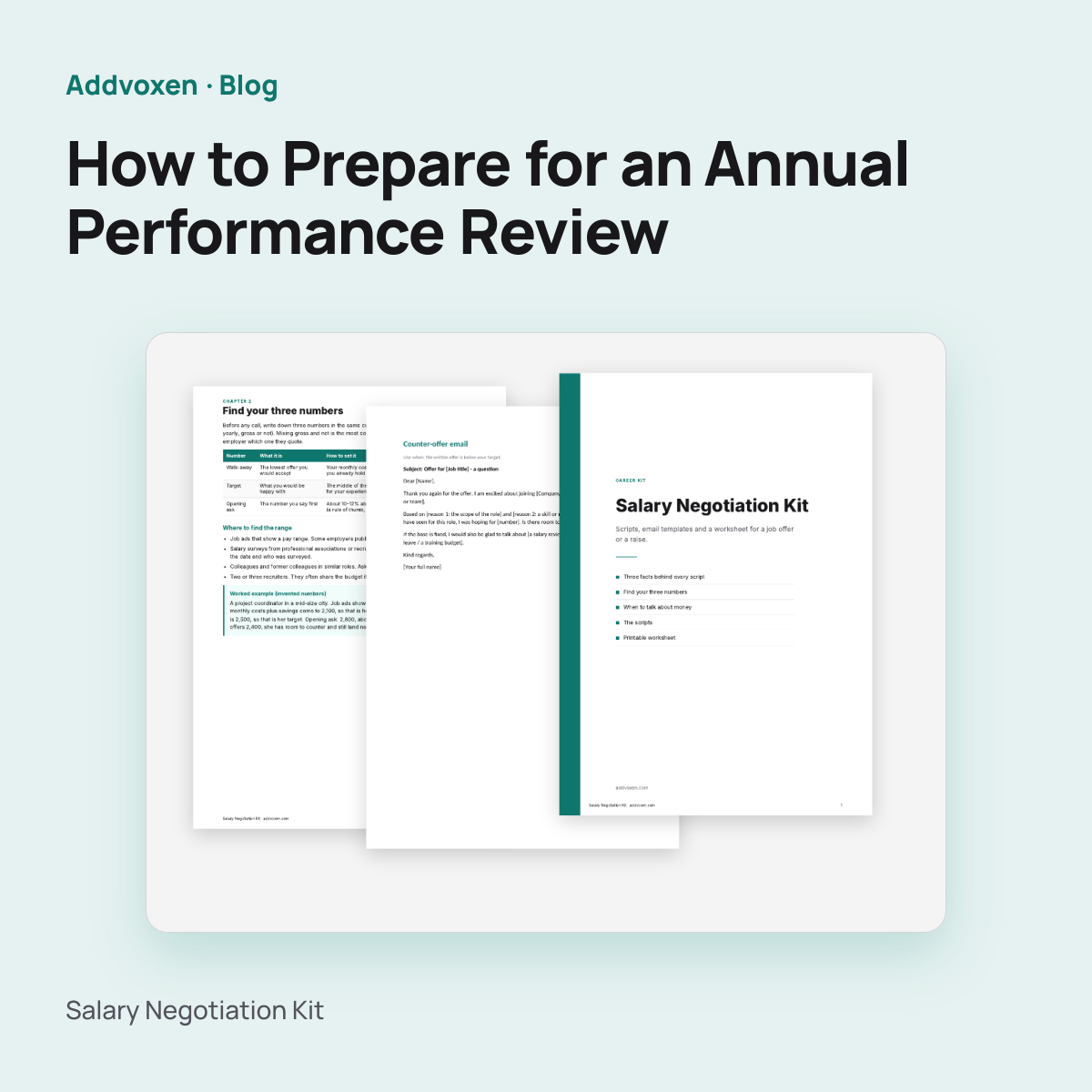
The Salary Negotiation Kit includes a template for asking a manager for a meeting about pay and one for asking for a review date after a no, in four languages. The evidence log above works with plain paper or any spreadsheet.