How to follow up on an unpaid invoice: templates by stage

By Amil Abbasov
· 5 min read
To follow up on an unpaid invoice, send a short, polite reminder one to three days after the due date, a firmer message about a week later, and a final notice a week after that. Each email repeats the invoice number, the amount, the original due date and how to pay. Call the client once if two emails get no answer. Keep every step in writing and every tone calm.
Below is a schedule you can copy, one template per stage, and the points where it is time to stop emailing and do something else.
When should you send the first reminder?
Wait until the invoice is actually overdue. A reminder before the due date reads as distrust, and a surprising number of "late" invoices are simply sitting in an approval queue.
If you want a gentler step, send one courtesy note two or three days before the due date. Then use this schedule, counted from the due date:
| Day | Step | Tone |
|---|---|---|
| +1 to +3 | Reminder 1 | Friendly, assumes an oversight |
| +7 to +10 | Reminder 2 and a phone call | Direct, asks for a payment date |
| +14 to +17 | Final notice | Formal, states what happens next |
These day counts are a sensible starting point, not a rule. Guides from Invoicebloom and Agiled suggest similar gaps (reminders at about 1, 7 and 14 days), but you should adjust them to your payment terms and your client's habits.
What should every follow-up email contain?
Every message, at every stage, should carry the same five facts so the reader never has to search for them:
- The invoice number in the subject line.
- The amount due and the currency.
- The original due date.
- How to pay (bank details or link), or the invoice attached again.
- One clear request: pay by a date, or tell you the date it will be paid.
Reply on the original email thread so the history is attached. Send it to the person who approves payments and copy the contact you worked with.
Template 1: the friendly reminder (1 to 3 days late)
Subject: Invoice 2026-014 – payment due 14 Nov
Hi Elena,
A quick note: invoice 2026-014 for €1,200 (website copy, October) was due on 14 November and I can't see the payment yet. I've attached it again for convenience.
If it has already gone out, thank you, and please ignore this. If something is holding it up, let me know and I'll fix it today.
Best, Your name
Why it works: it assumes a mistake, gives all five facts and offers help. Nobody is accused of anything.
Template 2: the direct follow-up (7 to 10 days late)
Subject: Invoice 2026-014 – now 8 days overdue
Hi Elena,
I wrote on 15 November about invoice 2026-014 (€1,200, due 14 November). It is still open on my side.
Could you confirm that it has been approved and tell me the date I can expect the payment? If you need a purchase-order number or different details on the invoice, send me what you need and I'll reissue it today.
I'll call you on Thursday if I haven't heard back, so we can sort it out quickly.
Best, Your name
The key line is the request for a date. "When will it be paid?" is easier to answer than "please pay", and an answer gives you something to hold the client to.
Should you pick up the phone?
Yes, once. After two unanswered emails, a short call often finds the real cause in a minute: the invoice went to the wrong person, a purchase order is missing, or the approver is away. Follow the call with a one-line email ("As discussed, payment will be made by 28 November") so the agreement is written down.
Template 3: the final notice (14 to 17 days late)
Subject: Final reminder: invoice 2026-014, €1,200
Hi Elena,
Invoice 2026-014 (€1,200, due 14 November) is now 16 days overdue and I haven't had a reply to my earlier messages.
Please arrange payment by 30 November. If I don't receive it or a confirmed payment date by then, I will have to pause further work on your account and look at the next steps in our agreement.
The invoice is attached again. If you believe there is an error, tell me what it is and I'll correct it straight away.
Regards, Your name
Only state a consequence you will really carry out, and only one your contract allows. Whether you can add late fees or interest, send a formal demand letter or pass the debt to a collector depends on your contract and local law. Confirm the rules locally, or ask a lawyer, before you write anything that sounds legal.
What should you avoid?
- Anger or sarcasm. A heated email is hard to take back and gives the client a reason to argue about tone instead of paying.
- Vague asks. "Please pay soon" produces nothing. A date does.
- Threats you won't act on. They cost you credibility on the next reminder.
- Starting a chain of one-line replies. Keep one thread, so the history is in one place.
- Chasing without records. If you can't say when you sent each reminder, you will lose track.
How do you stop chasing by memory?
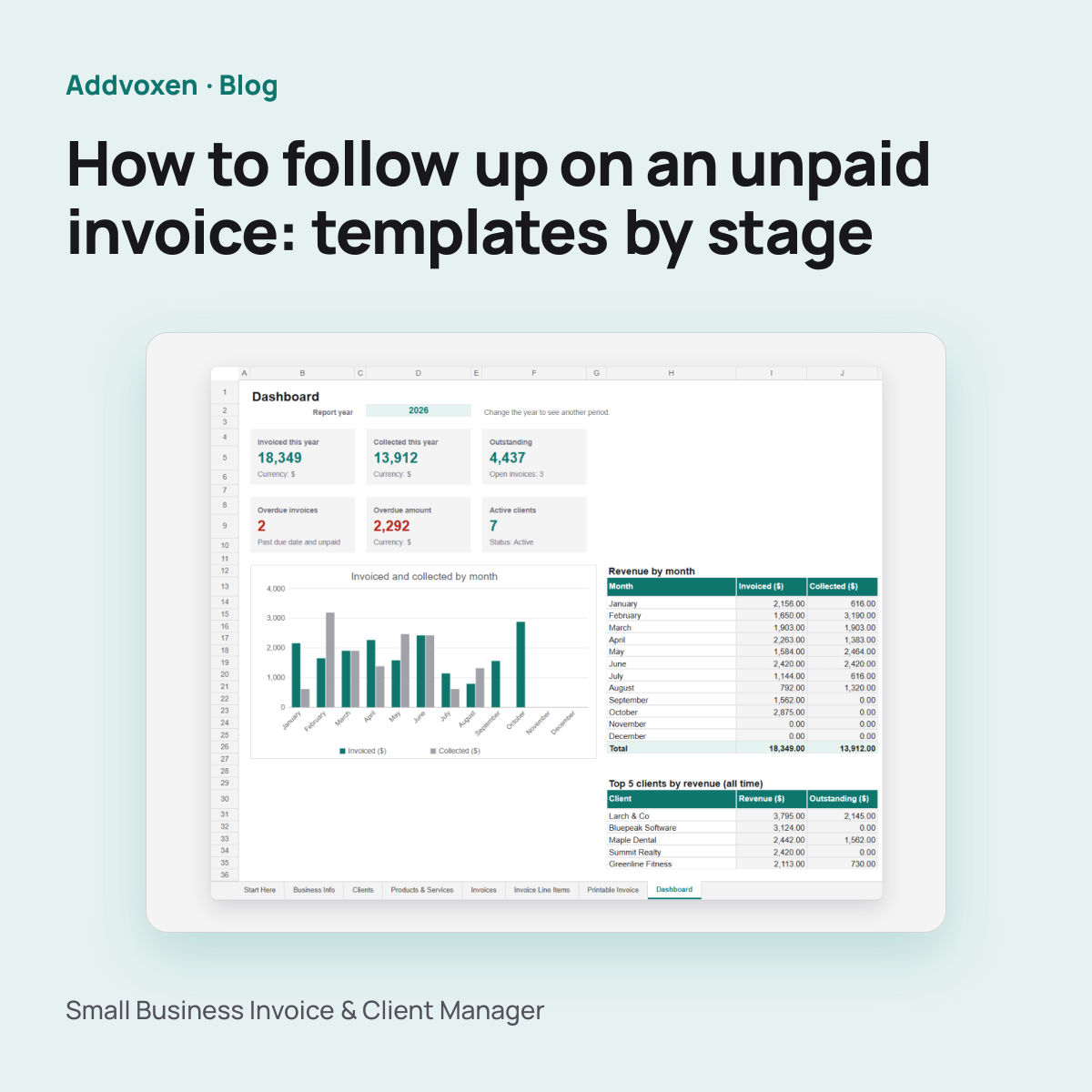
Write down three dates when you send the invoice: due date, first reminder, final notice. A register with a due-date column and a status formula shows you each morning which invoices are overdue and how many days late they are. If you'd rather not build that yourself, the Small Business Invoice & Client Manager has an invoice register with automatic Paid, Due or Overdue status, plus a dashboard of the outstanding total and overdue count.
Prevention matters too. Most of the details that delay payment are covered in how to write an invoice that gets paid on time: a clear due date, the right recipient and a payment link that works.