How to Ask for Time to Consider a Job Offer (With Wording)

By Amil Abbasov
· 4 min read
To ask for time to consider a job offer, thank the employer, say you are interested, name a specific date by which you will answer, and give a short reason. Two to five working days is a common request, but norms differ by country, industry and employer, so confirm what is normal where you are. Never go silent: a clear date is what keeps the employer comfortable.
This guide covers the moment the offer arrives. If you already know you want to negotiate the pay, see how to counter a job offer.
How long can you reasonably ask for?
There is no universal rule, and we will not pretend there is one. Employers often give a deadline in the offer itself. If they do, you can still ask for a short extension. If they do not, propose your own date.
A practical way to choose:
- Simple decision, no other process running: two or three working days.
- You need to read a contract, check notice terms or talk to family: three to five working days.
- You are waiting for another employer's answer: ask for the shortest time that makes this possible, and be honest that you are finishing another process.
Longer requests are harder to grant, because the employer may lose their second-choice candidate while they wait. If you ask for more than a week, expect questions. Check local norms on this with people in your field.
What do you say on the phone?
Offers often come by phone first. Do not answer yes or no on the spot. A calm script:
"Thank you, I am glad to hear that. I would like to give the offer proper thought. Could I come back to you by Thursday at noon? Meanwhile, could you send the details in writing?"
Three parts: gratitude, a specific day and time, and a request for the written offer. Asking for it in writing is normal and gives you something to review. Without a document you are deciding on a conversation you may remember differently tomorrow.
What do you write in the email?
If the offer arrives by email, reply within a day, even if you need longer to decide. A short acknowledgement protects the relationship.
Subject: Re: Offer for the Project Coordinator role
Hello Nigar,
Thank you for the offer. I am very interested in the role and the team.
I would like a few days to review the details properly. Could I confirm my answer by Friday, 27 November? If anything changes on your side before then, please let me know.
Best regards, Elvin
(The names, role and date are invented. Replace them with yours.)
Why it works: it states interest, asks for a bounded period and gives a date, so the employer can plan. It does not hint at a rival offer unless that is true and relevant.
What if the employer says no or gives less time?
Sometimes the answer is "we need to know tomorrow". Your options:
- Ask what is driving the deadline. "Is there a reason the date is fixed? I want to give you a considered answer." Sometimes it is a start-date issue, and a day or two is possible.
- Move the question to the missing information. If your hesitation is about a specific point, such as the probation period or the working hours, say so: "If I could get the contract today, I could answer tomorrow."
- Decide with what you have. If the deadline is firm and you are not satisfied, a polite decline is still an answer. Pressure to decide within hours, with no document, is also information about how the employer works.
How should you use the days?
The extra time is only useful if you spend it on specific checks. A short list:
- Read every line of the written offer: base pay (gross or net), bonus, probation, notice period, holiday, working hours, start date.
- Write down the three numbers you set before: your floor, your target and your opening ask. Compare the offer with them.
- Price the whole package, not just base pay. See how to compare two job offers beyond salary for a scoring method.
- Confirm local rules on contracts, notice and probation with an official source or a qualified adviser. We do not state them here because they vary.
- Decide by the date you promised. If you need one more day, ask early, not on the deadline day.
What mistakes should you avoid?
- Saying "I'll think about it" with no date. It sounds like a polite no.
- Using the time as leverage without saying so. If you plan to negotiate, say "I have a few questions about the package" and ask them.
- Accepting verbally, then asking for changes. Agree the terms first, then accept.
- Telling a current employer before you have a written offer. Wait until the offer is final.
- Missing your own deadline. If you said Friday, answer on Friday, even if the answer is "I need one more day, and here is why".
What do you do when the day comes?
You have three possible answers: accept, counter or decline. Each needs a short written message. If you accept, confirm the key terms in your reply. If you counter, use one number and one reason. If you decline, thank them and keep the door open.
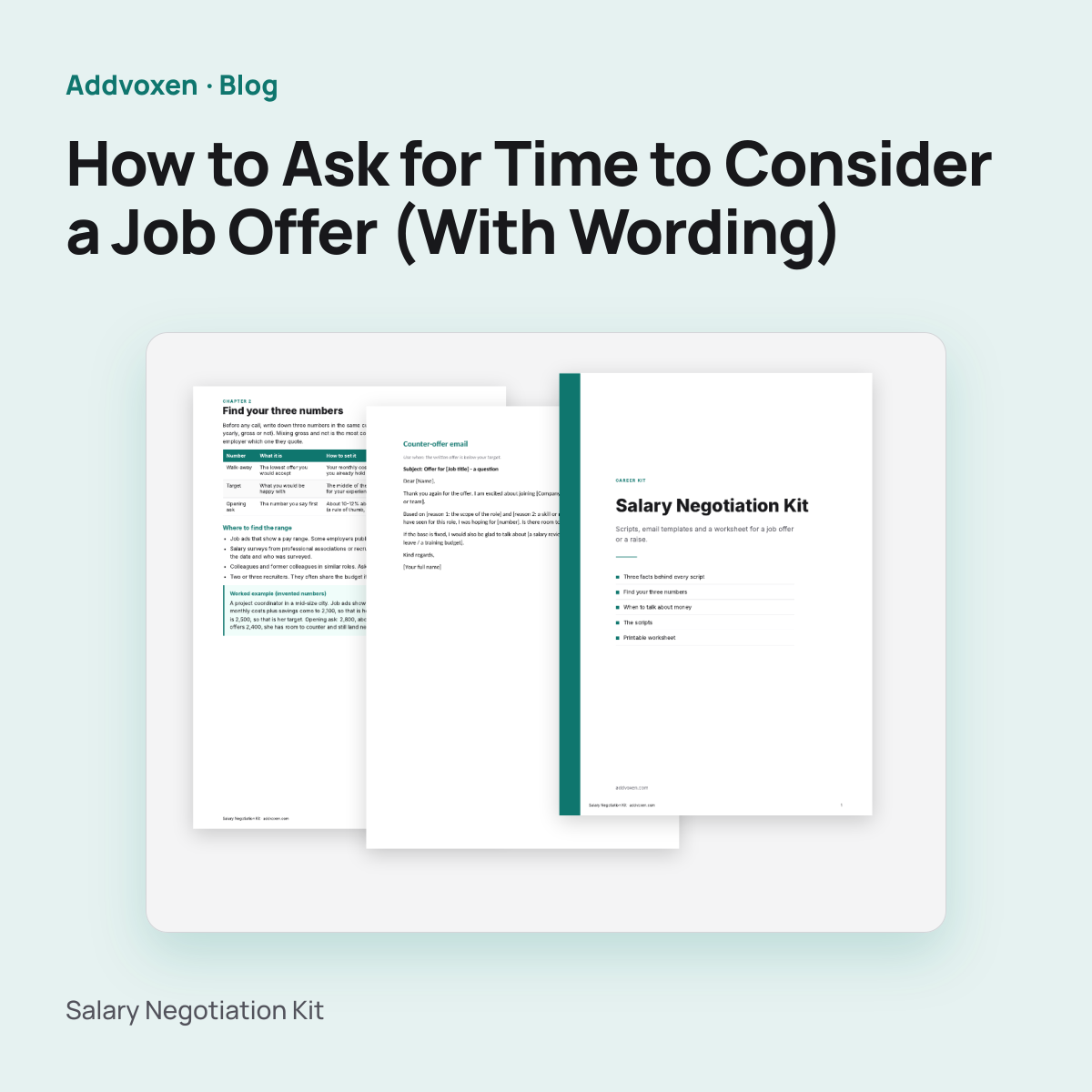
The Salary Negotiation Kit has fill-in templates for asking for the offer in writing, countering, accepting and asking for a review date, in four languages. The wording above works without it. The kit saves you drafting each message from scratch while you are under time pressure.